
The Best Robotic Pool Cleaners for Sloped Pools and Hopper Bottoms
Tracks get any of these robots up a slope; what separates them is how well they keep their heading on the way, and that is how we ranked them.
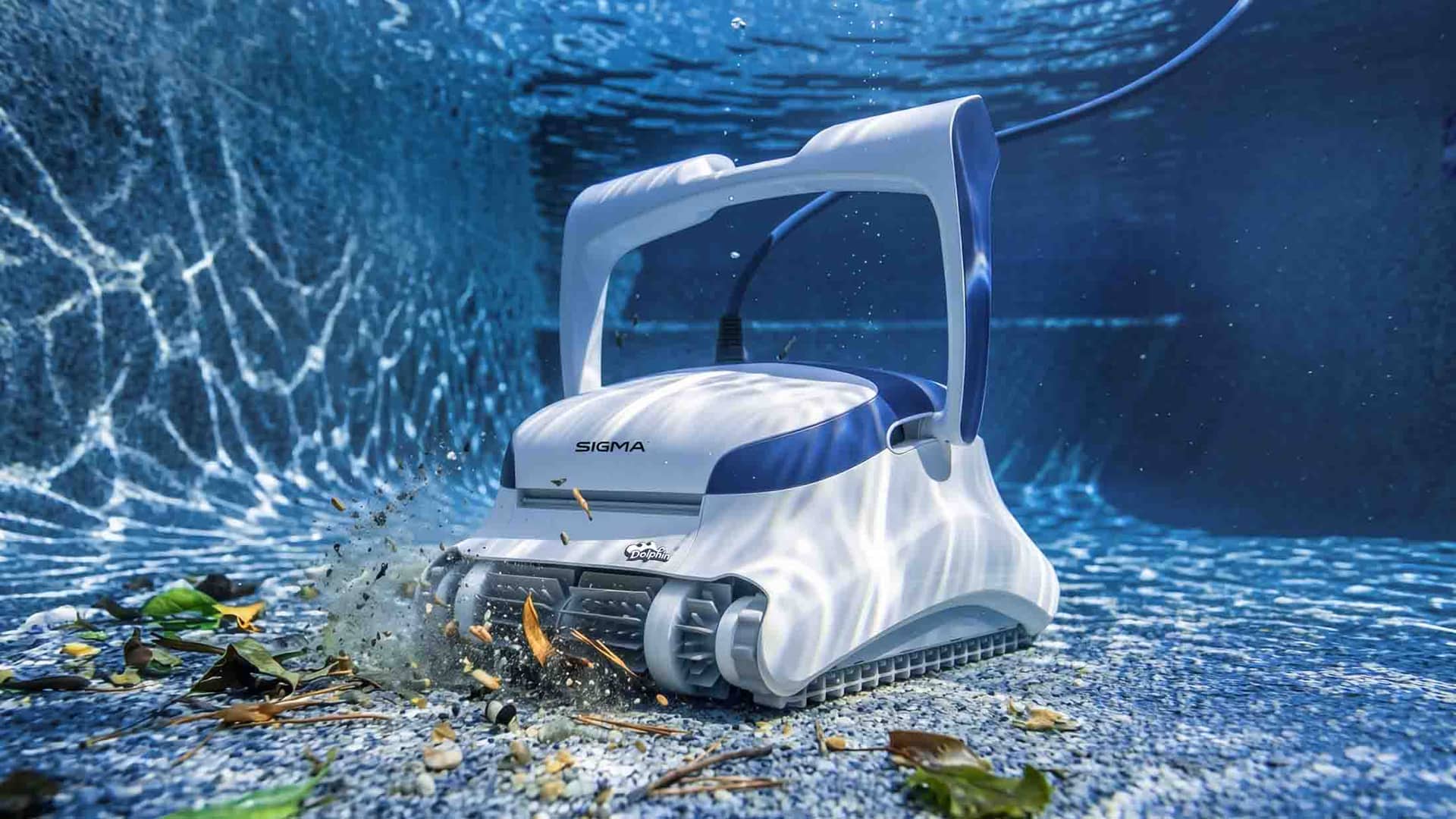
For a sloped floor, we would buy the Dolphin Sigma. Its onboard gyroscope senses the incline and holds the robot's line, so the shallow end gets the same attention as the deep end. The Dolphin Quantum is the runner-up for standard slopes at a lower price, with the Dolphin Premier close behind for long pools. The Dolphin Cayman handles slopes in pools up to 33 ft.
Almost every in-ground pool has a slope somewhere: the break from shallow to deep, the four angled sides of a hopper bottom, the gentle V of a sport pool. Shoppers who want the best robotic pool cleaner for sloped pools usually worry about grip. Will it make the climb? With tracked robots, that is rarely the problem. These machines climb vertical walls, and a floor slope is far gentler than a wall.
What actually goes wrong is direction. A robot heading across a slope gets nudged downhill, loses the line it was following and ends up re-cleaning the deep end while the shallow end waits. So our team ranks the Dolphin range here on navigation first, traction second and cycle time third.
Our four picks for a sloped floor
Ranked for this job, with today’s price on every card. Each robot ships free and carries the full manufacturer warranty.

Best at holding its line on a slope
Dolphin Sigma
The Sigma leads because it is the one robot here that knows it is on a hill. SmartNav 3.0 pairs its scanning with an onboard gyroscope that senses the incline, so when the slope pushes the robot off course it corrects and carries on with the lane it was cleaning.
The rest of the machine suits the climb: quad scrubbing brushes, HyperGrip tracks and a 55 ft swivel cable that does not tow it downhill. Anyone after the best robotic pool cleaner for steep slopes, hopper sides included, should start here.
- Best for
- Pools with a long or steep transition, hopper bottoms and owners who notice a neglected shallow end.
- Keep in mind
- You pay the most for it of any pick here, and its scheduling lives in the app instead of on the power supply.
Temporarily out of stock. Ships free from our warehouse

Standard slopes handled at a lower price
Dolphin Quantum
For an ordinary shallow-to-deep transition, the Quantum does the job without the Sigma's price. Its HyperGrip continuous rubber tracks keep contact along the whole incline, and dual HyperBrushes spinning at twice the speed of standard brushes scrub the ramp itself, where fine dirt streaks on its way down. SmartNav 2.0 scanning plans the route, and over a 2-hour cycle its passes cover both ends.
The swivel on its 55 ft cable matters here too, and the weekly timer, set to every day, every 2 days or every 3 days, means a patch missed on one run is picked up on the next.
- Best for
- A normal shallow-to-deep transition in a pool of up to 50 ft, with app or timer scheduling.
- Keep in mind
- It navigates by scanning alone, without a tilt sensor, so on a steep hopper expect it to need the full cycle to even out.
Temporarily out of stock. Ships free from our warehouse

Longest cycle to even out long slopes
Dolphin Premier
The Premier's answer to a slope is time. With a 3-hour cycle, half an hour more than the Sigma and a full hour more than the Quantum, it has more passes in which to reach the shallow end, the ramp and the deep end, even when individual lanes drift. SmartNav 2.0 scanning and HyperGrip tracks handle a standard transition without trouble, and dual ProLine motors pull 4,500 GPH through the debris that slides to the foot of the ramp.
It ranks third because the Quantum does the same job for less, and the Sigma corrects for the slope instead of out-waiting it.
- Best for
- Long in-ground pools where the slope runs most of the length and leaves collect at its foot.
- Keep in mind
- No tilt sensing and no phone control; if the shallow end is your problem area today, the Sigma addresses it more directly.
Temporarily out of stock. Ships free from our warehouse

Slope-capable pick for pools up to 33 ft
Dolphin Cayman
Smaller sloped pools do not need a 50 ft robot, and the Cayman covers them properly. It runs on HyperGrip tracks with SmartNav 2.0 scanning, weighs 14.6 lb and moves over 4,000 GPH with dual 24-volt DC motors. In a pool of 33 ft or less the ramp is short, so a 2-hour cycle crosses it many times.
Its timer runs every day, which suits a slope: whatever one cycle leaves at the top, the next one finds. The catch is the cable. It is 50 ft with no swivel, and on a slope a twisted cable tows the robot downhill, so straighten it regularly.
- Best for
- Compact in-ground pools with a shallow-to-deep break and owners happy with a daily run.
- Keep in mind
- No swivel and no waterline cleaning, and it is not rated for pools longer than 33 ft.
Temporarily out of stock. Ships free from our warehouse
What to look for in a robot for a sloped floor
-
Holding a heading on the incline
Gravity pulls a robot crossing a slope toward the low side. A robot that can sense its own tilt corrects for it. The Sigma is the one Dolphin in this guide with an onboard gyroscope; the others navigate by SmartNav 2.0 scanning and even out their coverage over the full cycle.
-
Track grip
All five run on HyperGrip tracks, and the Quantum's are continuous rubber tracks. Tracks keep a long strip of contact with the slope and go on pulling where a small contact patch would slip. On a standard transition, grip is not what separates these models.
-
The kind of slope you have
A steady shallow-to-deep ramp is the easy case. A hopper bottom has steep, short sides that a robot treats much like walls. A sport pool's V collects debris along the center line. Know which you own, because steepness changes where the dirt gathers.
-
Cable drag downhill
On a slope, a twisted cable does more than tangle: it tows the robot toward the deep end. The Sigma, Quantum and Premier have a swivel that lets the cable unwind as the robot turns. The Cayman's cable has no swivel and needs straightening by hand.
How the sloped-floor picks compare
The robots ranked above, spec for spec, with today’s price on each.
| Specification | Dolphin Sigma | Dolphin Quantum | Dolphin Premier | Dolphin Cayman |
|---|---|---|---|---|
| Price today | ||||
| Cleans | Floor, walls and waterline | Floor, walls, waterline, sun shelves and stairs | Floor, walls and waterline | Floor and walls |
| Traction | HyperGrip tracks | HyperGrip tracks | HyperGrip tracks | HyperGrip tracks |
| Navigation | SmartNav 3.0 with gyroscope | SmartNav 2.0 | SmartNav 2.0 | SmartNav 2.0 |
| Cable | 55 ft with 360° anti-tangle swivel | 55 ft with anti-tangle swivel | 55 ft with 360° anti-tangle swivel | 50 ft |
| Robot weight | 24.6 lb | 18.3 lb | 20.3 lb | 14.6 lb |
| Warranty | 3 years | 2 years | 3 years | 2 years |
| Details | See the Sigma (Dolphin Sigma) › | See the Quantum (Dolphin Quantum) › | See the Premier (Dolphin Premier) › | See the Cayman (Dolphin Cayman) › |
How can you tell if the slope is beating your robot?
Look at where the dirt is after a full cycle, not at the robot. A robot coping well leaves the shallow end, the ramp and the deep end about equally clean. A robot losing its heading leaves a tidy deep end and a dusty shallow end, because every lane that started across the slope finished at the bottom.
Before blaming navigation, rule out the two things that mimic it. A twisted cable pulls the robot toward the deep end. A full filter costs it the flow it needs to climb, so it stays low. Fix both and watch one more cycle. If the pattern is unchanged, that is the case for a robot with tilt sensing.
Hopper bottoms, V floors and other steep cases
A hopper bottom, common in vinyl liner pools, drops from the shallow floor into a small flat area through four angled sides. Where those sides are very steep, a robot handles them the way it handles walls: it climbs, scrubs and turns back. Expect debris to gather in the flat at the bottom and along the creases where the angled panels meet.
Vinyl adds one check. On a steep slope the liner needs to be tight, because tracks and brushes can catch on loose, wrinkled material and the robot may stall there. A sport pool is the gentle opposite: two shallow ends falling to a middle trough. Any pick here manages it.
What a robot will not do about a slope
It will not stop debris sliding. Leaves and silt migrate down the ramp between cycles, so the foot of the slope is the dirtiest part of the pool by design, and frequent cycles are the only cure. It will not fix a slippery surface either: an algae film on the slope means brushing and sanitizer first, robot second. The Escape, the fifth Dolphin we compare, also copes with a slope in a small pool, but its 1.5-hour cycle and 40 ft cable keep it off this shortlist.
How we would set it up
- Set the power supply near the middle of the pool's length or a little toward the deep end, so the cable has slack for the descent.
- Lay the cable out straight before each run. On a slope, a twist does not just tangle: it steers.
- Run more often instead of longer, because debris slides down the ramp between cycles.
- On a vinyl hopper, look over the slope and have any loose, raised wrinkles dealt with before the first run.
Sloped pool questions, answered
Does the best robotic pool cleaner for sloped pools need a gyroscope?
It helps, but it is not required. The Sigma's gyroscope senses the incline and corrects the robot's line, which matters most on long or steep slopes. On a standard transition, the other picks get there by scanning and track grip over a full cycle.
Can a robotic cleaner climb from the deep end back to the shallow end?
Yes. Every robot in this guide climbs vertical walls on HyperGrip tracks, and the ramp between deep and shallow is much less steep than a wall. If yours stays in the deep end, suspect a twisted cable or a full filter before you suspect the slope.
Why is my shallow end still dirty after a full cycle?
Usually because the robot keeps drifting downhill. Lanes that begin across the slope end at the bottom, so the deep end is cleaned repeatedly and the shallow end is shortchanged. Straighten the cable, empty the filter and run again. If nothing changes, a robot with tilt sensing, the Sigma here, is the fix.
What counts as a steep slope for a robot?
There is no published angle limit for these models, so we do not quote one. As a working guide, a normal shallow-to-deep ramp is easy, and the short, sharp sides of a hopper are handled like walls. Trouble is more likely from a loose liner or a slick surface than from steepness itself.
Do sport pools with a V-shaped floor need a special robot?
No. A sport pool's floor is two gentle slopes meeting at a low center line, well within what any pick here handles. Choose on length: the Cayman up to 33 ft, the Quantum, Premier or Sigma beyond that. Expect leaves and grit to line up along the center trough.
The decision for a sloped floor
Grip gets every one of these robots up a slope; direction decides whether the whole floor gets cleaned. If your slope is long, steep or a hopper, or your shallow end is the part that never looks done, buy the Sigma. For a standard transition, the Quantum does it for less, and the Premier suits long, leafy pools. Under 33 ft, the Cayman is enough. Whichever you choose, keep the cable straight and the filter empty, because both failures look exactly like a navigation problem.
The smartest place to buy your Dolphin

Lowest Price Guarantee
Buy direct from our 10,000+ unit warehouse at unbeatable prices, with price match.

Fast Free Shipping
Ships free from our warehouse, usually within one business day.

30-Day Returns & Warranty
Simple 30-day returns, plus the full manufacturer warranty: 2 or 3 years, by model.

1-on-1 Support
Talk to an in-house Dolphin expert before and after you buy.
Related buying guides
Still deciding?
Compare every Dolphin side by side, or talk to a pool-robot specialist to find your perfect match.